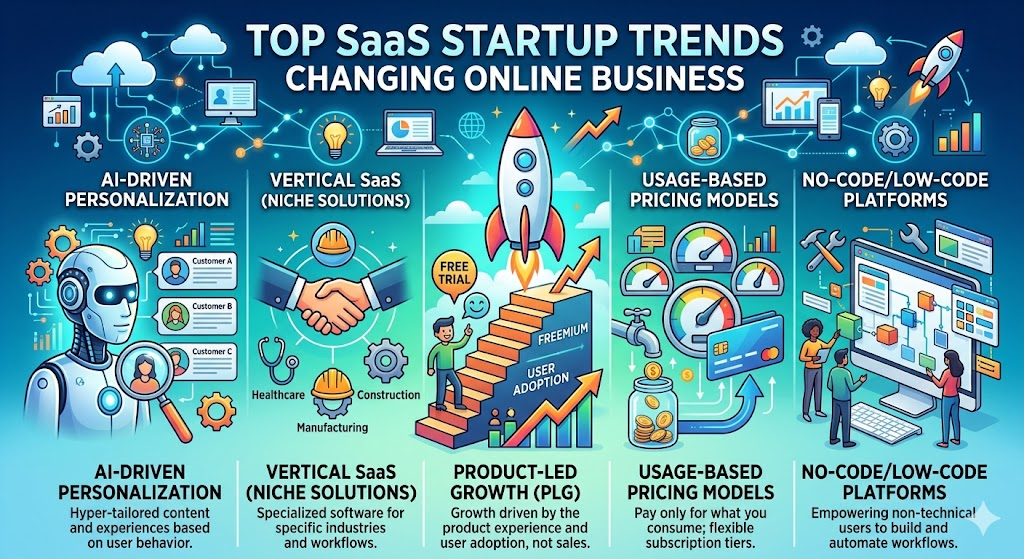
The SaaS industry is evolving at breakneck speed. Here’s a deep dive into the startup trends reshaping how we build, sell, and scale online businesses.
Introduction: The SaaS Revolution Is Far From Over
The Software-as-a-Service (SaaS) model has fundamentally transformed the way businesses operate online. What started as a simple shift from on-premise software to cloud-based subscriptions has now become a $197 billion global industry — and it’s projected to surpass $232 billion by 2026
But here’s the thing: the SaaS landscape of today looks nothing like it did five years ago.
New technologies, shifting buyer expectations, and economic pressures are forcing SaaS startups to rethink everything — from pricing models to product architecture. Whether you’re a founder launching your first product or an investor scanning the horizon for the next big opportunity, understanding these SaaS startup trends is no longer optional.
It’s essential.
In this comprehensive guide, we’ll explore the most impactful SaaS startup trends that are actively changing online business — and what they mean for your strategy moving forward.
Table of Contents
- AI-Powered SaaS Products
- Vertical SaaS Over Horizontal SaaS
- Product-Led Growth (PLG) Dominance
- Usage-Based Pricing Models
- Micro-SaaS and Solo Founders
- API-First Development
- Embedded Finance and Fintech Integration
- Low-Code and No-Code SaaS Platforms
- Hyper-Personalization Through Data
- SaaS Security and Compliance as a Priority
- The Rise of PLG + Community-Led Growth
- Sustainability and Green SaaS
1. AI-Powered SaaS Products
The Biggest SaaS Startup Trend of the Decade
Artificial intelligence isn’t just a feature anymore — it’s the foundation of a new generation of SaaS startups. From intelligent automation to predictive analytics, AI-powered SaaS products are delivering capabilities that were unthinkable just a few years ago.
Why this trend matters:
- Generative AI (think ChatGPT, Jasper, Midjourney) has opened entirely new product categories
- AI reduces manual workflows, cutting operational costs for end users by up to 40%
- Machine learning enables real-time decision-making at scale
- Natural language processing (NLP) is making software more intuitive and accessible
Real-world examples:
| Company | AI Application | Impact |
|---|---|---|
| Jasper | AI content generation | 100K+ users in under 2 years |
| Gong.io | Conversational intelligence for sales | $7.2B valuation |
| Notion AI | Integrated writing assistant | Expanded TAM significantly |
| Harvey AI | Legal document analysis | Raised $80M Series B |
What This Means for SaaS Founders
If you’re building a SaaS product in 2024 without an AI strategy, you’re already behind. The key is not to slap AI onto your product as a marketing gimmick. Instead, focus on solving a specific pain point where AI delivers measurable, repeatable value.
Pro Tip: The most successful AI-SaaS startups don’t sell “AI.” They sell outcomes — faster workflows, better decisions, reduced errors.
2. Vertical SaaS Over Horizontal SaaS
Niche Is the New Big
One of the most significant SaaS startup trends reshaping online business is the dramatic shift from horizontal SaaS (broad, general-purpose tools) to vertical SaaS (industry-specific solutions).
Horizontal SaaS targets every industry — think Slack, Salesforce, or HubSpot.
Vertical SaaS goes deep into a single industry — think Veeva Systems (pharma), Procore (construction), or Toast (restaurants).
Why vertical SaaS is winning:
- Higher retention rates — industry-specific tools are harder to replace
- Lower customer acquisition costs — targeted marketing to a defined audience
- Deeper moats — domain expertise creates competitive barriers
- Stronger pricing power — specialized solutions command premium pricing
Industries Ripe for Vertical SaaS Disruption
- Healthcare and telemedicine
- Legal tech
- Real estate management
- Agriculture and farming
- Logistics and supply chain
- Education and e-learning
- Cannabis and regulated industries
The data speaks for itself: Vertical SaaS companies typically achieve net revenue retention rates above 120%, compared to 100-110% for horizontal counterparts.
3. Product-Led Growth (PLG) Dominance
Let the Product Do the Selling
Product-Led Growth has evolved from a buzzword into the dominant go-to-market strategy for modern SaaS startups. Companies like Slack, Zoom, Calendly, Figma, and Notion didn’t grow through aggressive sales teams — they grew because their products were so good that users became advocates.
Core principles of PLG:
- Free trials or freemium models lower the barrier to entry
- Self-serve onboarding eliminates friction
- In-product virality drives organic acquisition
- Usage data informs upsell and expansion strategies
PLG by the Numbers
- PLG companies grow 2x faster than non-PLG peers (OpenView Partners)
- The median PLG company reaches $10M ARR 25% faster
- Companies with freemium models convert 2-5% of free users to paid
- PLG reduces Customer Acquisition Cost (CAC) by up to 60%
The PLG Playbook for SaaS Startups
textStep 1: Build a product that delivers value before the paywall
Step 2: Design frictionless onboarding (time-to-value under 5 minutes)
Step 3: Create natural share/invite mechanisms within the product
Step 4: Use product analytics to identify upgrade-ready users
Step 5: Layer in sales-assist for enterprise expansion
Key Insight: PLG doesn’t mean “no sales team.” The most successful PLG companies combine self-serve acquisition with strategic sales for enterprise deals. This hybrid model is sometimes called Product-Led Sales (PLS).
4. Usage-Based Pricing Models
Pay for What You Use — Not What You Might Use
The traditional SaaS pricing model — flat monthly subscription per seat — is being disrupted. Usage-based pricing (UBP) is emerging as one of the fastest-growing SaaS startup trends, driven by companies like Snowflake, Twilio, AWS, and Stripe.
Why usage-based pricing is gaining traction:
- Aligns cost with value — customers only pay for what they consume
- Lowers the entry barrier for small businesses and startups
- Creates natural revenue expansion as customers grow
- Reduces churn — customers don’t cancel; they simply use less during downturns
Usage-Based Pricing Adoption
According to OpenView’s 2026 SaaS Benchmarks Report:
- 61% of SaaS companies have adopted or are testing usage-based pricing
- Companies with UBP models see net dollar retention rates 15-20% higher than seat-based models
- UBP companies report faster time to first revenue
Common Usage-Based Pricing Metrics
| Industry | Pricing Metric |
|---|---|
| Cloud Infrastructure | Compute hours, storage GB |
| Communication APIs | API calls, messages sent |
| Data & Analytics | Queries processed, rows scanned |
| AI/ML Platforms | Tokens processed, model training hours |
| Email Marketing | Emails sent, contacts stored |
The Hybrid Approach
Many successful SaaS startups are adopting a hybrid pricing model — combining a base subscription fee with usage-based overages. This provides revenue predictability while still capturing expansion revenue.
5. Micro-SaaS and Solo Founders
Small Products, Big Profits
Not every SaaS startup needs to raise $50 million in venture capital. One of the most exciting SaaS startup trends is the rise of Micro-SaaS — small, focused software products built by solo founders or tiny teams that generate $10K to $100K+ in monthly recurring revenue (MRR).
What defines Micro-SaaS:
- Solves one specific problem extremely well
- Requires minimal overhead and infrastructure
- Often bootstrapped — no outside funding needed
- Built on top of existing platforms (Shopify, WordPress, Slack, Chrome)
- Operated by 1-5 people
Notable Micro-SaaS success stories:
- Carrd (one-page website builder) — solo founder, millions in revenue
- Plausible Analytics (privacy-friendly analytics) — 2-person team, profitable
- SavvyCal (scheduling tool) — bootstrapped to $1M+ ARR
- Bannerbear (automated image/video generation) — solo founder
Why Micro-SaaS Is Thriving
- AI and no-code tools make it possible to build products faster than ever
- Distribution platforms (Product Hunt, AppSumo, indie hacker communities) provide built-in audiences
- Remote work has normalized small, distributed teams
- The creator economy is producing founders who value independence over unicorn status
Trend Alert: The convergence of AI and Micro-SaaS is creating a new category — AI Micro-SaaS — where solo founders build AI-powered tools that automate niche workflows. Expect this category to explode in 2025-2026
6. API-First Development
Building for Integration, Not Isolation
Modern SaaS startups are increasingly taking an API-first approach — designing their products as programmable building blocks that other software can connect to, rather than standalone applications.
Why API-first is a defining SaaS startup trend:
- Businesses use an average of 130+ SaaS applications (Productiv data)
- Integration capability is now a top-3 buying criterion for B2B software
- API-first products create powerful network effects and switching costs
- Developers increasingly influence purchasing decisions
Iconic API-first SaaS companies:
- Stripe — payments infrastructure
- Twilio — communication APIs
- Plaid — financial data connectivity
- SendGrid — email delivery
- Algolia — search-as-a-service
The Composable Software Movement
API-first development is fueling the rise of composable architecture — where businesses assemble their tech stack from best-of-breed API components rather than relying on monolithic all-in-one platforms.
This creates massive opportunities for SaaS startups that can become the “Stripe of [industry]” — owning a critical layer of infrastructure in a specific domain.
7. Embedded Finance and Fintech Integration
Every SaaS Company Is Becoming a Fintech Company
One of the most profitable SaaS startup trends is the integration of financial services directly into SaaS platforms. This concept — known as embedded finance — allows SaaS companies to offer banking, lending, payments, and insurance without building financial infrastructure from scratch.
Examples in action:
- Shopify Capital offers loans to merchants directly within the Shopify platform
- Toast provides payment processing for restaurants
- Mindbody enables payment processing for fitness businesses
- ServiceTitan offers financing options for home service businesses
Why Embedded Finance Is a Game-Changer
- Revenue diversification — financial services can add 2-5x revenue per customer
- Increased stickiness — customers who use your financial tools are significantly less likely to churn
- Higher LTV — payment processing alone can increase customer lifetime value by 200-500%
- Better unit economics — financial revenue often has higher margins than core SaaS subscription
The Infrastructure Enabling This Trend
Companies like Stripe Treasury, Unit, Bond, and Moov Financial provide the banking-as-a-service (BaaS) infrastructure that allows SaaS startups to embed financial services without obtaining banking licenses.
8. Low-Code and No-Code SaaS Platforms
Democratizing Software Creation
The low-code and no-code movement is one of the most transformative SaaS startup trends for online business. These platforms empower non-technical users — marketers, operations managers, entrepreneurs — to build applications, automate workflows, and create digital experiences without writing code.
Market growth:
- The no-code/low-code market is expected to reach $65 billion by 2027
- Gartner predicts that 70% of new applications will use low-code/no-code technologies by 2025
- Forrester estimates that the low-code market is growing at 40% year-over-year
Leading platforms in this space:
| Platform | Primary Use Case |
|---|---|
| Webflow | Website design and CMS |
| Bubble | Full-stack web applications |
| Airtable | Database and workflow management |
| Zapier | Workflow automation |
| Retool | Internal tools |
| Glide | Mobile apps from spreadsheets |
| Make (Integromat) | Complex automation workflows |
Impact on SaaS Startups
Low-code/no-code tools are creating a dual opportunity:
- As products — Building a no-code platform is itself a massive SaaS opportunity
- As enablers — SaaS founders can use these tools to prototype, launch, and validate products faster than ever before
Many successful SaaS startups now launch their MVP using no-code tools, validate product-market fit, and only invest in custom development after proving demand.
9. Hyper-Personalization Through Data
One Size Fits None
Today’s SaaS users expect experiences tailored specifically to their needs, behaviors, and preferences. Hyper-personalization — powered by advanced data analytics, machine learning, and behavioral tracking — is becoming a critical differentiator for SaaS startups.
What hyper-personalization looks like in SaaS:
- Dynamic onboarding flows that adapt based on user role, industry, or goals
- Personalized dashboards that surface the most relevant metrics for each user
- Intelligent feature recommendations based on usage patterns
- Customized email sequences triggered by in-product behavior
- Adaptive pricing that adjusts based on company size or usage level
The Data Behind Personalization
- 80% of consumers are more likely to purchase from brands offering personalized experiences (Epsilon)
- Personalized onboarding can increase activation rates by 30-50%
- SaaS companies using behavioral data for upsells see 15-25% higher expansion revenue
Tools Powering SaaS Personalization
- Segment — customer data platform
- Amplitude — product analytics
- Mixpanel — user behavior tracking
- Intercom — personalized messaging
- Mutiny — website personalization for B2B
Key Takeaway: The SaaS startups that win in 2024 and beyond won’t just build great products — they’ll build products that feel like they were designed specifically for each individual user.
10. SaaS Security and Compliance as a Priority
Trust Is the New Currency
As SaaS products handle increasingly sensitive data — financial records, health information, personal communications — security and compliance have moved from afterthoughts to foundational requirements.
Why this SaaS startup trend is accelerating:
- High-profile data breaches have made buyers more security-conscious
- Regulations like GDPR, CCPA, HIPAA, and SOC 2 are becoming table stakes
- Enterprise buyers now require detailed security questionnaires before purchasing
- Cyber insurance providers are demanding higher security standards
Security as a Competitive Advantage
Forward-thinking SaaS startups are treating security not as a cost center but as a growth lever:
- SOC 2 compliance can accelerate enterprise sales cycles by 40-60%
- GDPR compliance opens access to the European market (500M+ consumers)
- Zero-trust architecture reduces breach risk and builds customer confidence
- Transparent security practices (public security pages, bug bounty programs) build brand trust
The Rise of Security-Focused SaaS
This trend has also created a booming market for security SaaS startups themselves:
- Vanta — automates SOC 2 and HIPAA compliance
- Drata — continuous compliance monitoring
- Snyk — developer-first security
- Wiz — cloud security platform
- 1Password for Business — enterprise password management
11. The Rise of PLG + Community-Led Growth
Building Moats Through Community
One of the most underrated SaaS startup trends is the combination of Product-Led Growth (PLG) with Community-Led Growth (CLG). Smart SaaS founders are realizing that products attract users, but communities retain them.
What Community-Led Growth looks like:
- User forums and communities (e.g., Figma Community, Notion Templates)
- Slack and Discord groups where users help each other
- User-generated content — templates, plugins, integrations, tutorials
- Events and meetups — both virtual and in-person
- Champion programs that reward power users
Why Community Creates a Defensible Moat
- Network effects — the community becomes more valuable as it grows
- Reduced support costs — users help each other
- Organic acquisition — community members become evangelists
- Product insights — direct feedback loops accelerate product development
- Switching costs — leaving the product means leaving the community
SaaS companies excelling at CLG:
- Notion — massive template-sharing community
- Figma — plugin and design community
- dbt — developer community around data transformation
- Webflow — active user community with marketplace
- HubSpot — extensive academy, forums, and partner ecosystem
12. Sustainability and Green SaaS
Building Software with a Conscience
Sustainability is no longer just a corporate buzzword — it’s becoming a meaningful SaaS startup trend that influences purchasing decisions, especially among millennial and Gen Z decision-makers.
How SaaS startups are embracing sustainability:
- Choosing green cloud providers powered by renewable energy
- Optimizing code and infrastructure for energy efficiency
- Offering carbon footprint tracking as a product feature
- Adopting B Corp certification and ESG reporting
- Building products that help other businesses reduce their environmental impact
Why this matters commercially:
- 73% of millennials are willing to pay more for sustainable products (Nielsen)
- ESG-focused companies attract more institutional investment
- Government procurement increasingly favors vendors with sustainability commitments
- Sustainability can be a meaningful differentiator in crowded markets
The Future of SaaS Startups: What’s Coming Next
Looking beyond current trends, several emerging forces will shape the next wave of SaaS startup innovation:
Predictions for 2026 and Beyond
- AI agents will replace traditional SaaS dashboards — users will interact with software through conversational interfaces rather than clicking through menus
- Blockchain-based SaaS will enable decentralized applications with built-in data ownership
- Voice-first SaaS will emerge for industries where hands-free interaction is critical
- Outcome-based pricing will go mainstream — pay only when the software delivers measurable results
- SaaS consolidation will accelerate as platform players acquire vertical solutions
- Edge computing will enable SaaS products that work offline and sync when connected
Key Takeaways for SaaS Founders and Entrepreneurs
If you’re building or scaling a SaaS startup in 2024, here’s your action checklist:
✅ Integrate AI meaningfully — not as a gimmick, but as a core value driver
✅ Consider going vertical — depth beats breadth in today’s market
✅ Adopt Product-Led Growth — let your product be your best salesperson
✅ Experiment with usage-based pricing — align your revenue with customer value
✅ Build community early — it’s your most defensible competitive advantage
✅ Prioritize security from Day 1 — it accelerates enterprise adoption
✅ Leverage no-code tools — move faster and validate before you build
✅ Personalize everything — from onboarding to pricing to communication
✅ Think about embedded finance — it can transform your unit economics
✅ Stay lean if possible — the Micro-SaaS model proves you don’t need millions to win
Conclusion: Adapt or Get Left Behind
The SaaS industry is in the middle of a profound transformation. The trends we’ve explored — from AI-powered products and vertical specialization to usage-based pricing and community-led growth — aren’t just passing fads. They represent fundamental shifts in how software is built, sold, and consumed.
The SaaS startups that will thrive in the coming years are those that embrace these trends early, experiment relentlessly, and stay obsessively focused on delivering real value to their customers.
The opportunity has never been larger. The tools have never been more accessible. And the playbook has never been clearer.
The question isn’t whether these SaaS startup trends will reshape online business.
The question is: will you be leading the change, or chasing it?
Found this guide valuable? Share it with a fellow founder who’s building the next great SaaS product.
Frequently Asked Questions (FAQ)
What are the top SaaS startup trends in 2024?
The top SaaS startup trends include AI-powered products, vertical SaaS, product-led growth, usage-based pricing, Micro-SaaS, API-first development, embedded finance, low-code/no-code platforms, hyper-personalization, and enhanced security compliance.
What is the difference between vertical SaaS and horizontal SaaS?
Horizontal SaaS serves multiple industries with broad functionality (e.g., Slack, HubSpot), while vertical SaaS targets a single industry with deep, specialized features (e.g., Veeva for pharma, Toast for restaurants).
How is AI changing the SaaS industry?
AI is transforming SaaS by enabling intelligent automation, predictive analytics, natural language interfaces, personalized user experiences, and entirely new product categories like generative AI tools.
What is Product-Led Growth (PLG) in SaaS?
Product-Led Growth is a go-to-market strategy where the product itself drives customer acquisition, conversion, and expansion through free trials, freemium models, self-serve onboarding, and in-product virality.
What is Micro-SaaS?
Micro-SaaS refers to small, focused software products typically built by solo founders or small teams, solving a specific niche problem and generating sustainable revenue without venture capital funding.
Why is usage-based pricing becoming popular in SaaS?
Usage-based pricing aligns cost with value, lowers entry barriers for customers, naturally expands revenue as usage grows, and reduces churn compared to traditional flat-rate subscription models.
