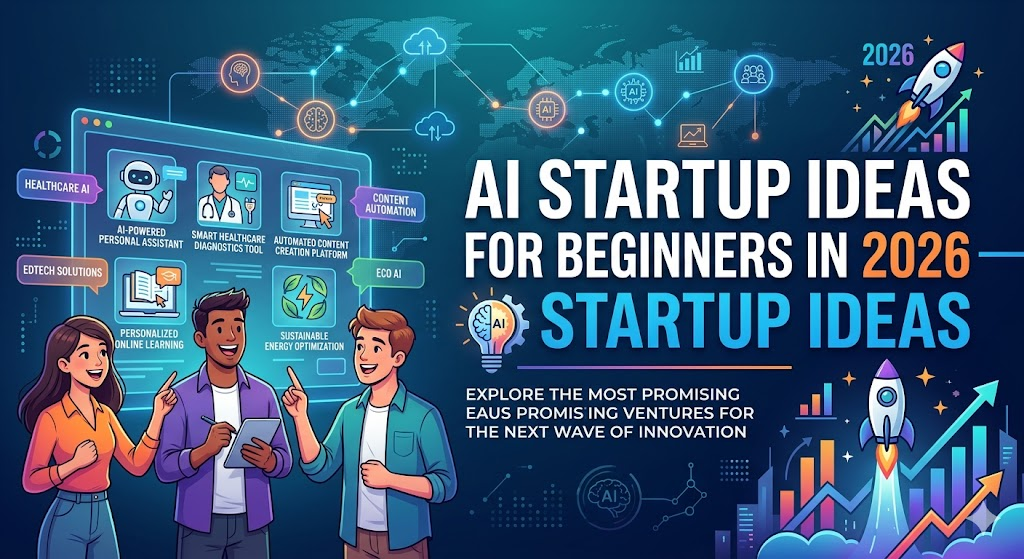
The artificial intelligence revolution isn’t slowing down — it’s accelerating. By 2026, the global AI market is projected to surpass $300 billion, creating unprecedented opportunities for aspiring entrepreneurs. If you’ve been searching for AI startup ideas that are accessible, profitable, and future-proof, you’ve landed in the right place.
This comprehensive guide explores the most promising AI startup ideas for beginners in 2026, breaking down each opportunity with actionable insights, market potential, and practical steps to get started — even if you don’t have a technical background.
Table of Contents
- Why 2026 Is the Perfect Year to Launch an AI Startup
- What Makes a Great AI Startup Idea for Beginners
- Top 20 AI Startup Ideas for Beginners in 2026
- Low-Code and No-Code AI Startup Opportunities
- How to Validate Your AI Startup Idea
- Common Mistakes to Avoid
- Frequently Asked Questions
<a name=”why-2026″></a>Why 2026 Is the Perfect Year to Launch an AI Startup
The convergence of several powerful trends makes 2026 a golden window for AI entrepreneurs:
- Democratized AI tools — Platforms like OpenAI, Hugging Face, and Google Vertex AI have dramatically lowered the barrier to entry
- Mature infrastructure — Cloud computing costs continue to decline while processing power increases
- Enterprise adoption surge — Businesses of all sizes are actively seeking AI solutions, creating massive demand
- Venture capital interest — AI startups attracted over $50 billion in global funding in 2024, and investment continues to grow
- Regulatory clarity — Governments are establishing clearer AI frameworks, reducing uncertainty for new ventures
Key Insight: You don’t need to build foundational AI models from scratch. The most successful beginner-friendly AI startups in 2026 will focus on applying existing AI capabilities to solve specific, real-world problems.
<a name=”what-makes-great”></a>What Makes a Great AI Startup Idea for Beginners
Before diving into specific ideas, let’s establish the criteria that separate winning AI startup concepts from the rest:
Essential Characteristics
| Criteria | Why It Matters |
|---|---|
| Clear problem-solution fit | Your AI must solve a real, painful problem people will pay to fix |
| Low technical barrier | Leverage existing APIs, pre-trained models, and no-code tools |
| Scalable business model | SaaS, marketplace, or platform models that grow without proportional cost |
| Defined target audience | Niche focus beats trying to serve everyone |
| Defensible moat | Data advantages, network effects, or deep domain expertise |
| Ethical foundation | Responsible AI practices build trust and long-term viability |
<a name=”top-20″></a>Top 20 AI Startup Ideas for Beginners in 2026
1. AI-Powered Content Creation Agency
Market Opportunity: The content marketing industry is worth over $600 billion globally, and businesses desperately need high-quality content at scale.
The Concept: Build a hybrid agency that combines AI writing tools (like GPT-based models) with human editorial oversight to produce blog posts, social media content, email campaigns, and product descriptions.
Why It Works for Beginners:
- Minimal upfront investment required
- You can start as a solo founder
- Recurring revenue through monthly retainers
- AI handles the heavy lifting; humans add creativity and quality control
Revenue Potential: $5,000 – $50,000+ per month
Getting Started:
- Choose your niche (e.g., SaaS companies, e-commerce, healthcare)
- Master 2-3 AI writing platforms
- Develop quality control workflows
- Build a portfolio with sample projects
- Acquire clients through LinkedIn outreach and content marketing
2. AI Customer Support Chatbot Platform
Market Opportunity: The chatbot market is expected to reach $15.5 billion by 2028, driven by businesses seeking 24/7 customer support without massive staffing costs.
The Concept: Create an easy-to-deploy AI chatbot solution that small and medium businesses can integrate into their websites, apps, and social media channels within minutes.
Why It Works for Beginners:
- No-code chatbot builders already exist — you add vertical specialization
- Strong recurring SaaS revenue model
- SMBs represent an underserved, massive market
- Upselling opportunities (analytics, multilingual support, integrations)
Revenue Potential: $10,000 – $100,000+ per month with scale
Competitive Advantage: Focus on a specific industry — real estate chatbots, restaurant ordering bots, or healthcare appointment bots — to differentiate from generic platforms.
3. AI Resume and Career Coaching Platform
Market Opportunity: With millions of job seekers competing globally, personalized career tools powered by AI have enormous demand.
The Concept: Build a platform that uses AI to analyze resumes, optimize them for ATS (Applicant Tracking Systems), provide personalized career coaching, conduct mock interviews via AI, and match candidates with suitable roles.
Why It Works for Beginners:
- Freemium model drives rapid user acquisition
- High willingness to pay among job seekers
- AI APIs for NLP and sentiment analysis are readily available
- Low infrastructure costs
Revenue Model: Freemium with premium tiers ($9.99 – $49.99/month), plus B2B partnerships with recruiting firms.
4. AI-Driven Personalized Education Platform
Market Opportunity: The EdTech market will exceed $400 billion by 2027, with personalized learning being the fastest-growing segment.
The Concept: Develop an AI-powered learning platform that adapts to each student’s pace, learning style, strengths, and weaknesses. The AI creates personalized lesson plans, practice problems, and real-time feedback.
Target Audiences:
- K-12 students and parents
- College students preparing for exams
- Professionals seeking upskilling
- Language learners
Why It Works for Beginners:
- Pre-built educational content can be curated and enhanced with AI
- Subscription-based recurring revenue
- Partnership opportunities with schools and tutoring centers
- Strong social impact angle attracts grants and impact investors
5. AI Health and Wellness Assistant
Market Opportunity: The digital health market is projected to reach $660 billion by 2027.
The Concept: Create an AI-powered wellness app that provides personalized nutrition plans, workout routines, mental health check-ins, sleep optimization, and habit tracking — all tailored to individual user data.
Important Considerations:
- Stay within wellness/coaching boundaries (not medical diagnosis)
- Include appropriate disclaimers
- Partner with certified health professionals for credibility
- Ensure HIPAA compliance if handling health data in the US
Revenue Model: Subscription ($7.99 – $19.99/month), premium coaching add-ons, corporate wellness partnerships.
6. AI-Powered E-Commerce Product Description Generator
Market Opportunity: Over 26 million e-commerce stores exist worldwide, and each needs compelling product descriptions that convert.
The Concept: Build a specialized SaaS tool that generates SEO-optimized, conversion-focused product descriptions using AI. Users input basic product details, and the tool produces ready-to-publish descriptions in multiple styles and languages.
Key Features to Include:
- Multi-language support
- SEO keyword integration
- Tone customization (luxury, casual, technical)
- Bulk generation capability
- Platform integration (Shopify, WooCommerce, Amazon)
Revenue Potential: $3,000 – $30,000/month through tiered SaaS pricing
7. AI Social Media Management Tool
Market Opportunity: Social media management is a $25+ billion industry growing at 23% annually.
The Concept: Build an AI-powered platform that automates social media content creation, scheduling, engagement analysis, hashtag research, competitor monitoring, and audience insights — specifically designed for small businesses and solopreneurs.
Differentiation Strategy: While Hootsuite and Buffer exist, there’s a significant gap in AI-native social media tools that actually create content, not just schedule it.
Key AI Features:
- Automated post generation from URLs, product photos, or briefs
- Optimal posting time prediction
- Sentiment analysis of comments and mentions
- AI-generated response suggestions
- Trend prediction and content recommendations
8. AI Legal Document Assistant for Small Businesses
Market Opportunity: Small businesses spend an average of $12,000 – $30,000 annually on legal services, much of which involves routine document work.
The Concept: Create an AI platform that helps small businesses generate, review, and understand common legal documents — contracts, NDAs, terms of service, privacy policies, employment agreements, and lease agreements.
Why It Works:
- Massive pain point for SMBs (legal costs are prohibitive)
- NLP technology is mature enough for document analysis
- High perceived value = strong pricing power
- Template + AI customization model is highly scalable
Important Note: Include clear disclaimers that the tool provides legal information, not legal advice, and encourage users to consult attorneys for complex matters.
9. AI-Powered Real Estate Investment Analyzer
Market Opportunity: Real estate investment technology is booming, with millions of investors seeking data-driven decision-making tools.
The Concept: Develop an AI tool that analyzes property listings, neighborhood data, market trends, rental income potential, ROI projections, and risk factors to help investors make smarter decisions.
Key Features:
- Automated property valuation
- Cash flow projection modeling
- Neighborhood analysis (schools, crime, development plans)
- Comparable property analysis
- Market trend prediction
- Risk scoring
Revenue Model: Subscription tiers ($29 – $199/month) targeting individual investors, real estate agents, and property management firms.
10. AI Meeting Assistant and Productivity Tool
Market Opportunity: Knowledge workers spend an average of 31 hours per month in unproductive meetings, creating enormous demand for solutions.
The Concept: Build an AI-powered meeting assistant that automatically transcribes meetings, generates summaries, extracts action items, tracks follow-ups, and integrates with project management tools.
Competitive Landscape: While Otter.ai and Fireflies exist, there’s room for vertical-specific meeting assistants (sales meetings, medical consultations, legal depositions, academic lectures).
Revenue Model: Freemium with premium tiers ($12 – $49/user/month), enterprise licensing.
11. AI-Powered Influencer Marketing Platform
The Concept: Create a platform that uses AI to match brands with the right influencers based on audience demographics, engagement authenticity, brand alignment, and predicted campaign performance.
Key Differentiator: AI-driven fake follower detection and ROI prediction — solving two of the biggest pain points in influencer marketing.
Revenue Model: Commission-based (10-20% of campaign value) plus subscription fees.
12. AI Financial Planning and Budgeting App
The Concept: Build a personal finance app that uses AI to analyze spending patterns, predict future expenses, optimize savings, recommend investment strategies, and provide personalized financial advice.
Target Market: Millennials and Gen Z who prefer digital-first financial management.
Revenue Model: Freemium, premium subscriptions ($5.99 – $14.99/month), affiliate partnerships with financial institutions.
13. AI-Powered Language Translation Service for Businesses
The Concept: Offer an AI-powered translation platform specifically designed for business communication — emails, documents, presentations, marketing materials, and customer support — with industry-specific terminology accuracy.
Key Differentiator: Unlike Google Translate, focus on business context accuracy, brand voice consistency, and industry-specific jargon.
Industries to Target: Legal, medical, technology, manufacturing, tourism, e-commerce.
14. AI Interior Design and Home Staging Platform
Market Opportunity: The interior design market exceeds $150 billion globally, with virtual staging growing rapidly.
The Concept: Create an AI tool that generates interior design recommendations, virtual room staging, furniture placement suggestions, and color scheme ideas based on photos of existing spaces.
Use Cases:
- Homeowners planning renovations
- Real estate agents staging properties virtually
- Interior designers accelerating their workflow
- E-commerce furniture retailers helping customers visualize products
Revenue Model: Pay-per-design, subscription plans, B2B partnerships with furniture retailers.
15. AI Cybersecurity Monitoring for Small Businesses
Market Opportunity: Cybersecurity spending will exceed $300 billion by 2026, yet most SMBs remain underprotected.
The Concept: Develop an affordable, AI-powered cybersecurity monitoring platform designed specifically for small businesses — detecting threats, monitoring vulnerabilities, ensuring compliance, and providing automated incident response.
Why This Is Huge:
- 43% of cyberattacks target small businesses
- Most existing solutions are too expensive or complex for SMBs
- AI enables automated threat detection at a fraction of enterprise costs
- Regulatory compliance requirements are increasing globally
Revenue Model: Monthly subscription ($49 – $299/month per business
16. AI-Powered Restaurant and Food Service Optimization
The Concept: Build an AI platform that helps restaurants optimize menu pricing, predict demand, reduce food waste, manage inventory, schedule staff, and personalize marketing to customers.
Key Value Proposition: Restaurants operate on 3-5% profit margins — even small AI-driven optimizations can dramatically improve profitability.
17. AI Video Editing and Production Tool
Market Opportunity: Video content dominates digital marketing, yet professional video editing remains time-consuming and expensive.
The Concept: Create an AI-powered video editing platform that automates editing tasks — cutting, transitions, color grading, subtitle generation, thumbnail creation, and format optimization for different platforms.
Target Audience: YouTubers, TikTok creators, small business marketers, course creators, podcasters.
18. AI-Powered Supply Chain Optimization for SMBs
The Concept: Develop an accessible AI tool that helps small and medium manufacturers, retailers, and distributors optimize their supply chains — demand forecasting, inventory management, supplier evaluation, and logistics optimization.
Why Now: Post-pandemic supply chain disruptions have made this a top priority for businesses of all sizes.
19. AI Pet Care and Veterinary Assistant
Market Opportunity: The global pet care market exceeds $320 billion, with pet owners increasingly willing to invest in their pets’ health.
The Concept: Build an AI-powered app that helps pet owners monitor their pets’ health, track symptoms, receive breed-specific care recommendations, find nearby veterinarians, set medication reminders, and access a symptom checker.
Revenue Model: Freemium app with premium features, vet clinic partnerships, pet product affiliate marketing.
20. AI-Powered Local Business Marketing Platform
The Concept: Create an all-in-one AI marketing platform specifically for local businesses — automating Google Business Profile optimization, local SEO, review management, social media posting, email campaigns, and ad management.
Why This Works:
- Millions of local businesses need digital marketing help
- Most can’t afford agencies or full-time marketers
- AI can automate 80% of routine local marketing tasks
- Strong recurring revenue potential
Revenue Model: $49 – $199/month per business, white-label options for agencies.
<a name=”low-code”></a>Low-Code and No-Code AI Startup Opportunities
One of the most exciting developments for beginners is the rise of no-code and low-code AI platforms that eliminate the need for deep programming expertise.
Best Platforms for Building AI Startups Without Coding
| Platform | Best For | Pricing |
|---|---|---|
| Bubble + AI APIs | Web applications with AI features | Free tier available |
| Zapier + OpenAI | Workflow automation with AI | Starting at $19.99/month |
| Voiceflow | AI chatbots and voice assistants | Free tier available |
| Obviously AI | Predictive analytics tools | Starting at $75/month |
| Typeform + AI | Smart forms and surveys | Starting at $25/month |
| Lovable / Bolt | Full-stack AI app development | Various pricing |
| FlutterFlow | Mobile apps with AI integration | Free tier available |
How Beginners Can Leverage These Tools
- Identify a niche problem in an industry you understand
- Prototype quickly using no-code platforms
- Integrate AI APIs (OpenAI, Claude, Gemini) for intelligence
- Launch an MVP within weeks, not months
- Iterate based on user feedback before investing in custom development
<a name=”validate”></a>How to Validate Your AI Startup Idea Before Investing
Validation is the most critical step that many aspiring entrepreneurs skip. Here’s a proven framework:
Step 1: Problem Validation
- Talk to 50+ potential customers before building anything
- Identify whether the problem is a “vitamin” (nice to have) or “painkiller” (must solve)
- Quantify how much time or money the problem costs
Step 2: Solution Validation
- Create a landing page describing your AI solution
- Run small ad campaigns ($100-$500) to gauge interest
- Collect email signups and measure conversion rates
- Conduct pre-sales or collect letters of intent
Step 3: Technical Validation
- Confirm that existing AI APIs can deliver the required functionality
- Build a minimum viable product (MVP) in 4-8 weeks
- Test accuracy, speed, and reliability with beta users
Step 4: Business Model Validation
- Calculate unit economics — customer acquisition cost (CAC) vs. lifetime value (LTV)
- Ensure LTV is at least 3x CAC for sustainability
- Identify your path to $10,000 monthly recurring revenue (MRR) within 12 months
Step 5: Market Validation
- Analyze competitors — if there are zero competitors, that’s often a warning sign
- Identify your unique value proposition (UVP)
- Confirm the market is large enough to support your growth goals
<a name=”mistakes”></a>Common Mistakes to Avoid When Starting an AI Business
Mistake 1: Building Technology Without a Customer
The Fix: Always start with the problem, not the technology. AI is a tool, not a product.
Mistake 2: Trying to Compete With Big Tech
The Fix: Don’t build a general-purpose AI. Focus on narrow, vertical-specific applications where domain expertise matters more than model size.
Mistake 3: Ignoring Data Privacy and Ethics
The Fix: Implement privacy-by-design principles from day one. Comply with GDPR, CCPA, and emerging AI regulations. Build trust through transparency.
Mistake 4: Over-Engineering the MVP
The Fix: Launch with the minimum feature set that solves the core problem. You can always add features later based on user feedback.
Mistake 5: Underestimating Go-to-Market Strategy
The Fix: Allocate at least 50% of your effort to distribution, marketing, and sales. The best AI product in the world fails without customers.
Mistake 6: Neglecting the Human Element
The Fix: The most successful AI startups combine AI efficiency with human judgment. Position your solution as augmenting humans, not replacing them.
Mistake 7: Pricing Too Low
The Fix: Charge based on the value you deliver, not your costs. If your AI saves a business $5,000/month, charging $200/month is reasonable and profitable.
Funding Your AI Startup in 2026
Bootstrap-Friendly Options
- Revenue-funded growth — Start generating revenue immediately with a service model
- AI-focused grants — NSF SBIR, Google for Startups, Microsoft for Startups, NVIDIA Inception
- Crowdfunding — Platforms like Kickstarter or Republic for consumer-facing AI products
When to Seek Investment
- You’ve validated product-market fit
- You have paying customers and growing revenue
- You need capital to scale, not to figure out what to build
AI-Focused Accelerators and Incubators
- Y Combinator — Actively investing in AI startups
- Techstars — Multiple AI-focused programs
- Google for Startups Accelerator: AI
- Microsoft for Startups Founders Hub
- NVIDIA Inception Program
- Antler — Global presence with AI focus
Essential Skills for AI Entrepreneurs in 2026
You don’t need to be a machine learning engineer to launch a successful AI startup. Here are the skills that matter most:
Must-Have Skills
- ✅ Problem identification and validation
- ✅ Product management and UX thinking
- ✅ Basic understanding of how AI models work (not building them)
- ✅ Sales and customer development
- ✅ Digital marketing fundamentals
- ✅ Financial literacy and business modeling
Nice-to-Have Skills
- ✅ Python basics for API integration
- ✅ Data analysis and visualization
- ✅ Prompt engineering
- ✅ Understanding of AI ethics and bias
Skills You Can Outsource
- Deep machine learning engineering
- Advanced frontend/backend development
- Legal and compliance
- Graphic design and branding
<a name=”faq”></a>Frequently Asked Questions
Can I start an AI startup without coding skills?
Absolutely. With no-code platforms, AI APIs, and the ability to hire freelance developers, technical execution is more accessible than ever. Your primary job as a founder is to identify problems, understand customers, and build a business — not write code.
How much money do I need to start an AI startup in 2026?
You can launch an AI startup MVP for as little as $500 – $5,000 using no-code tools and existing AI APIs. Service-based AI businesses (like an AI content agency) can start with virtually zero capital.
What is the most profitable AI startup idea for beginners?
AI SaaS products targeting business customers (B2B) typically offer the highest profit margins and most predictable revenue. Among the ideas listed, AI customer support chatbots, AI legal document assistants, and AI marketing platforms for local businesses offer excellent profit potential for beginners.
How long does it take to build an AI startup?
With focused execution:
- MVP development: 4-12 weeks
- First paying customers: 2-4 months
- Product-market fit: 6-12 months
- Sustainable profitability: 12-24 months
Do I need a co-founder for an AI startup?
Not necessarily, but having a complementary co-founder significantly increases your chances of success. If you’re non-technical, a technical co-founder is invaluable. If you’re technical, a business-savvy co-founder helps with sales, marketing, and operations.
What are the biggest risks of starting an AI startup?
- Technology risk — AI models may not perform accurately enough for your use case
- Market risk — Your target customers may not be willing to pay
- Competitive risk — Large companies or well-funded startups may enter your space
- Regulatory risk — New AI regulations could impact your business model
- Ethical risk — Bias, privacy issues, or misuse could damage your reputation
Is the AI startup market oversaturated?
While competition is increasing, the market is far from saturated. The key is specificity — instead of building “an AI writing tool,” build “an AI writing tool for veterinary clinics” or “an AI writing tool for Shopify product descriptions in German.” Niche focus creates defensibility.
Final Thoughts: Your AI Startup Journey Starts Now
The window of opportunity for AI startups in 2026 is wide open, but it won’t stay that way forever. Early movers who identify real problems, build focused solutions, and execute relentlessly will capture significant market share before the space becomes crowded.
Here’s your action plan for the next 30 days:
- Week 1: Choose 3 ideas from this list that excite you and align with your skills
- Week 2: Conduct 15+ customer discovery interviews for each idea
- Week 3: Select the strongest idea based on validation data
- Week 4: Build a landing page, start collecting signups, and begin your MVP
The best AI startup ideas aren’t the most technically impressive — they’re the ones that solve real problems for real people and generate sustainable revenue. You don’t need to build the next ChatGPT. You need to find a painful problem, apply AI intelligently, and build a business that grows.
The future of AI entrepreneurship belongs to those who start. Start today.
Found this guide helpful? Share it with someone who’s thinking about starting an AI business in 2026. Have questions about a specific AI startup idea? Drop them in the comments below.
