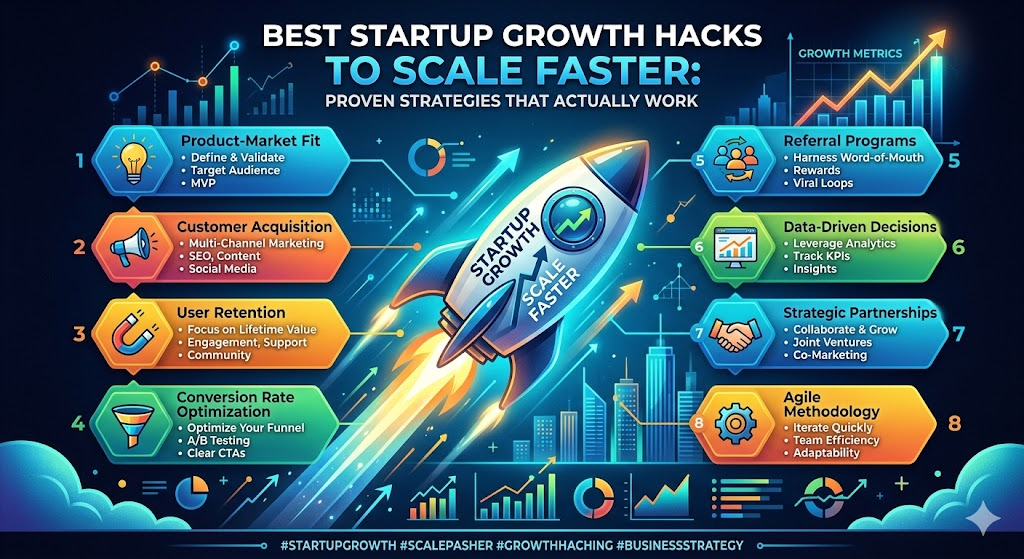
Introduction: Why Startup Growth Hacks Matter More Than Ever
Building a startup is exhilarating, but scaling it fast is where the real challenge begins. In today’s hyper-competitive landscape, traditional marketing playbooks simply don’t cut it anymore. That’s where startup growth hacks come in — unconventional, data-driven, and resource-efficient strategies designed to accelerate growth exponentially.
Growth hacking isn’t just a buzzword. It’s a mindset. Companies like Dropbox, Airbnb, Slack, and Uber didn’t scale by accident. They leveraged creative, repeatable, and scalable growth strategies that propelled them from obscurity to billion-dollar valuations in record time.
In this comprehensive guide, we’ll explore the best startup growth hacks to scale faster, backed by real-world examples, actionable frameworks, and expert insights. Whether you’re a bootstrapped founder or a venture-backed CEO, these strategies will help you unlock sustainable, explosive growth.
Table of Contents
- What Is Growth Hacking?
- The Growth Hacking Mindset
- Product-Led Growth Hacks
- Viral Loop and Referral Growth Hacks
- Content Marketing Growth Hacks
- SEO Growth Hacks for Startups
- Social Media Growth Hacks
- Email Marketing Growth Hacks
- Community-Driven Growth Hacks
- Partnership and Integration Growth Hacks
- Data-Driven Growth Hacks
- Pricing and Monetization Growth Hacks
- Common Growth Hacking Mistakes to Avoid
- FAQs About Startup Growth Hacks
What Is Growth Hacking? {#what-is-growth-hacking}
Growth hacking is a process of rapid experimentation across marketing channels, product development, sales segments, and other areas of the business to identify the most efficient ways to grow. The term was coined by Sean Ellis in 2010, and it has since become the cornerstone of startup strategy.
Unlike traditional marketing, growth hacking:
- Focuses on speed and scalability over brand-building
- Relies on data and analytics rather than gut feelings
- Blends marketing with product engineering to create self-sustaining growth loops
- Prioritizes low-cost, high-impact tactics that maximize ROI
“A growth hacker is a person whose true north is growth. Everything they do is scrutinized by its potential impact on scalable growth.” — Sean Ellis
Growth Hacking vs. Traditional Marketing
| Factor | Traditional Marketing | Growth Hacking |
|---|---|---|
| Budget | Large budgets required | Lean and resourceful |
| Approach | Brand-first | Growth-first |
| Speed | Slow and methodical | Fast experimentation |
| Focus | Awareness and reach | Acquisition, activation, retention |
| Tools | Ads, PR, events | Product, data, automation |
| Measurement | Impressions, reach | Revenue, retention, virality |
The Growth Hacking Mindset {#the-growth-hacking-mindset}
Before diving into specific tactics, it’s essential to understand the growth hacking mindset. Without the right mental framework, even the best strategies will fall flat.
1. Think in Terms of the AARRR Framework
Dave McClure’s Pirate Metrics (AARRR) framework is the foundation of growth hacking:
- Acquisition — How do users find you?
- Activation — Do users have a great first experience?
- Retention — Do users come back?
- Revenue — How do you make money?
- Referral — Do users tell others about you?
Every growth hack should map to at least one of these stages. The most powerful hacks address multiple stages simultaneously.
2. Embrace the Build-Measure-Learn Loop
Inspired by Eric Ries’ Lean Startup methodology, growth hacking thrives on rapid iteration:
- Build a minimum viable experiment
- Measure the results with precise metrics
- Learn what worked and what didn’t
- Repeat — faster each time
3. Prioritize with the ICE Framework
Not all growth experiments are created equal. Use the ICE scoring model to prioritize:
- Impact — How much will this move the needle?
- Confidence — How sure are you it will work?
- Ease — How quickly can you execute it?
Score each experiment from 1–10 on all three dimensions, then focus on the highest-scoring ideas first.
Product-Led Growth Hacks {#product-led-growth-hacks}
Product-led growth (PLG) is the most powerful growth engine a startup can build. When your product itself drives acquisition, conversion, and expansion, you create a self-sustaining flywheel that compounds over time.
Hack #1: Build a Freemium Model That Creates Addiction
Why it works: Freemium reduces the barrier to entry to zero, allowing users to experience your product’s value before paying.
How to execute:
- Offer a genuinely useful free tier that solves a core problem
- Design natural upgrade triggers based on usage limits
- Ensure the free version showcases your best features — don’t cripple it
- Use in-app prompts to highlight premium features at the moment of need
Real-world example: Slack offered unlimited free usage with a 10,000-message searchable limit. Teams fell in love with the product and naturally upgraded when they hit the limit.
Key insight: The best freemium models give away 90% of the product to 90% of users and monetize the 10% who derive outsized value.
Hack #2: Optimize Your Onboarding for the “Aha Moment”
The “aha moment” is the point where a new user first realizes the value of your product. Finding and accelerating this moment is one of the highest-leverage growth hacks available.
Steps to find and optimize your aha moment:
- Analyze user behavior data — What do retained users do differently in their first session?
- Identify the key action — For Facebook, it was adding 7 friends in 10 days. For Dropbox, it was uploading the first file.
- Remove friction before the aha moment — eliminate unnecessary steps, forms, and distractions
- Guide users toward the action using tooltips, checklists, progress bars, and welcome sequences
Pro tip: Use tools like Mixpanel, Amplitude, or Heap Analytics to map the correlation between specific onboarding actions and long-term retention.
Hack #3: Create Sticky Features That Increase Switching Costs
Products that become deeply embedded in users’ workflows are nearly impossible to abandon.
Strategies for stickiness:
- Data storage — The more data users store in your product, the harder it is to leave (e.g., Notion, Airtable)
- Integrations — Connect with tools users already depend on (e.g., Zapier, HubSpot)
- Collaboration — Multi-user products create network effects within teams (e.g., Figma, Google Workspace)
- Customization — Allow users to build workflows, templates, and automations that are unique to their needs
Hack #4: Ship Fast, Iterate Faster
Speed is your competitive advantage as a startup. While large companies spend months planning, you should be deploying weekly experiments.
Tactical approaches:
- Set a minimum of 2–3 growth experiments per week
- Use feature flags to test new features with a subset of users
- Implement A/B testing on everything — landing pages, onboarding flows, pricing pages, CTAs
- Create a growth experimentation log to track learnings and avoid repeating failures
Viral Loop and Referral Growth Hacks {#viral-loop-and-referral-growth-hacks}
Viral growth is the holy grail of scaling. When each user brings in more than one additional user, you achieve exponential, compounding growth at minimal marginal cost.
Hack #5: Engineer a Built-In Viral Loop
A viral loop is a mechanism where using the product naturally exposes it to new potential users.
Types of viral loops:
| Loop Type | Mechanism | Example |
|---|---|---|
| Inherent virality | Product requires sharing to function | Zoom (invite to meetings), WhatsApp |
| Collaborative virality | Product is better with others | Google Docs, Notion |
| Word-of-mouth virality | Product is so good people talk about it | Tesla, Superhuman |
| Incentivized virality | Users get rewards for sharing | Dropbox, PayPal, Robinhood |
| Embedded virality | Product embeds branding in output | Mailchimp (“Sent via Mailchimp”), Canva |
Key metric: Viral Coefficient (K-factor)
K = Number of invites sent per user × Conversion rate of invites
- K > 1 = Exponential viral growth
- K = 1 = Stable user base
- K < 1 = Growth depends on other channels
Hack #6: Design an Irresistible Referral Program
Dropbox’s referral program is perhaps the most famous growth hack in startup history. By offering 500MB of free storage for every friend referred, Dropbox grew from 100,000 to 4,000,000 users in just 15 months — a 3,900% increase.
How to build a referral program that actually works:
- Offer double-sided incentives — Reward both the referrer and the referred (e.g., “Give $20, Get $20”)
- Make sharing effortless — One-click sharing via email, SMS, social media, and unique referral links
- Offer rewards that align with your product — Storage space for cloud apps, credits for SaaS tools, features for premium products
- Create urgency — Limited-time referral bonuses or tiered rewards that increase with more referrals
- Track and display progress — Show users how many referrals they’ve made and what rewards they’ve earned
Pro tip: Use tools like ReferralCandy, Viral Loops, or GrowSurf to automate your referral program.
Hack #7: Leverage the “Powered By” Badge
This deceptively simple hack has driven millions of sign-ups for companies like Hotjar, Typeform, Intercom, and Mailchimp.
How it works:
- Add a small “Powered by [Your Brand]” badge to the user-facing output of your product
- Every customer becomes a distribution channel — their users and customers see your branding
- The badge links to your website or sign-up page
- Works exceptionally well for B2B products with high external visibility (forms, chatbots, email tools, analytics widgets)
Results: Hotjar attributed a significant portion of its early growth to its “Powered by Hotjar” badge displayed on heatmaps and recordings.
Content Marketing Growth Hacks {#content-marketing-growth-hacks}
Content marketing remains one of the most cost-effective and compounding growth channels for startups. The key is creating content that serves a strategic purpose beyond just “publishing blog posts.”
Hack #8: Create a Flagship Content Asset
Instead of publishing dozens of mediocre blog posts, create one definitive resource that becomes the go-to reference in your industry.
Examples of flagship content:
- HubSpot’s “State of Marketing” Report — Generated thousands of backlinks and media mentions annually
- Buffer’s “Ideal Length of Everything Online” — Still drives traffic years after publication
- Ahrefs’ SEO guides — Comprehensive resources that rank for hundreds of keywords each
How to create flagship content:
- Identify a topic your target audience desperately needs answers on
- Research more thoroughly than anyone else has
- Include original data, expert quotes, or proprietary insights
- Make it visually stunning with custom graphics, charts, and infographics
- Update it regularly to maintain freshness and rankings
- Promote it aggressively — outreach, social, communities, paid amplification
Hack #9: Repurpose Content Across Multiple Channels
One piece of content should live at least 10 different lives. This maximizes ROI and reach without proportionally increasing effort.
The content repurposing framework:
textBlog Post → Twitter/X Thread → LinkedIn Carousel → YouTube Video →
Podcast Episode → Instagram Reels → Email Newsletter → Quora Answer →
Reddit Post → SlideShare Presentation → Infographic → Guest Post
Tools to streamline repurposing:
- Repurpose.io — Automatically distribute video/audio content
- Canva — Create visual content from written insights
- Descript — Turn video content into blog posts and social clips
- ChatGPT/Claude — Adapt content for different formats and audiences
Hack #10: Build Interactive Tools and Calculators
Interactive content generates 2x more conversions than passive content and earns significantly more backlinks.
Examples:
- CoSchedule’s Headline Analyzer — A free tool that drives massive traffic and email sign-ups
- HubSpot’s Website Grader — Generates leads by offering personalized website audits
- Shopify’s Business Name Generator — Attracts entrepreneurs at the earliest stage
How to implement:
- Identify a calculation, assessment, or evaluation your audience regularly needs
- Build a simple tool (use Outgrow, Typeform, or custom development)
- Gate the results behind an email capture (or leave it ungated for maximum virality)
- Optimize the tool’s landing page for SEO
- Promote through communities and relevant forums
SEO Growth Hacks for Startups {#seo-growth-hacks-for-startups}
Search engine optimization is one of the most sustainable growth channels. Unlike paid advertising, SEO compounds over time — the content you create today can drive traffic for years.
Hack #11: Programmatic SEO at Scale
Programmatic SEO involves creating thousands of landing pages automatically using templates and databases. This is how companies like Zapier, Yelp, TripAdvisor, and Wise dominate search results.
How Zapier does it:
- Zapier has thousands of pages like “How to connect [App A] with [App B]”
- Each page is auto-generated using a template + database of 5,000+ app integrations
- These pages collectively rank for millions of long-tail keywords
Steps to implement programmatic SEO:
- Identify a repeatable page format (e.g., “[City] + [Service],” “[Tool A] vs. [Tool B],” “[Industry] + [Resource]”)
- Build a database of variables to populate the templates
- Create a high-quality template with unique, valuable content for each variation
- Ensure each page provides genuine value — Google penalizes thin, duplicated content
- Implement proper internal linking between pages
- Monitor performance and iterate on the template
Hack #12: Target Bottom-of-Funnel Keywords First
Most startups make the mistake of targeting broad, high-volume keywords. Instead, focus on high-intent, bottom-of-funnel keywords that drive conversions.
Keyword categories to prioritize:
| Priority | Keyword Type | Example | Intent |
|---|---|---|---|
| 1 | Comparison | “[Your brand] vs [competitor]” | Purchase decision |
| 2 | Alternative | “Best [competitor] alternatives” | Switching intent |
| 3 | Solution-aware | “Best [solution category] for [use case]” | Evaluation |
| 4 | Problem-aware | “How to [solve specific problem]” | Research |
| 5 | Informational | “What is [broad topic]” | Awareness |
Pro tip: Create dedicated comparison pages for every major competitor. These pages convert at 5–10x the rate of informational content.
Hack #13: Build Topical Authority with Content Clusters
Google increasingly rewards websites that demonstrate deep expertise in specific topics over those that cover many topics superficially.
How to build a content cluster:
- Choose a pillar topic (e.g., “startup growth hacking”)
- Create a comprehensive pillar page covering the topic broadly
- Write 10–20 cluster articles addressing specific subtopics in depth
- Interlink all cluster articles to the pillar page and to each other
- Update and expand the cluster regularly
Structure example for a “Growth Hacking” cluster:
textPillar: "The Complete Guide to Startup Growth Hacking"
├── "Best Referral Program Strategies for Startups"
├── "Product-Led Growth: The Definitive Guide"
├── "Growth Hacking Tools Every Startup Needs"
├── "How to Calculate and Improve Your Viral Coefficient"
├── "Startup Onboarding Best Practices"
├── "Freemium vs Free Trial: Which Converts Better?"
├── "A/B Testing for Startups: A Practical Guide"
├── "Community-Led Growth Strategies"
├── "How to Build a Growth Team from Scratch"
└── "Growth Hacking Case Studies: Lessons from Unicorns"
Hack #14: Earn Backlinks Through Digital PR and Data Studies
Backlinks remain one of the strongest ranking factors in Google’s algorithm. Instead of begging for links, create content that naturally earns them.
High-link-earning content formats:
- Original research and surveys — Journalists and bloggers cite data
- Industry benchmarks — Become the definitive source for metrics
- Controversial or contrarian takes — Spark debate and sharing
- Free tools and resources — People link to useful assets
- Expert roundups and interviews — Contributors share and link back
Social Media Growth Hacks {#social-media-growth-hacks}
Social media can be a powerful growth engine when used strategically. The key is choosing the right platforms and creating content that triggers sharing, engagement, and conversion.
Hack #15: Build in Public
Building in public — sharing your startup journey transparently — has become one of the most effective social media growth strategies, especially on Twitter/X and LinkedIn.
What to share:
- Revenue milestones (and failures) with real numbers
- Product development updates with behind-the-scenes footage
- Customer feedback and testimonials
- Lessons learned from mistakes and pivots
- Team hiring and culture moments
- Growth metrics and experiment results
Why it works:
- Creates authentic connections with your audience
- Generates organic engagement and shares
- Attracts potential customers, investors, and talent
- Positions you as a thought leader in your space
Case study: Pieter Levels (founder of Nomad List and Remote OK) built a massive following and customer base by sharing his revenue, experiments, and coding process publicly on Twitter. His transparency turned followers into loyal customers.
Hack #16: Leverage User-Generated Content (UGC)
User-generated content is more trusted, more engaging, and cheaper than brand-created content.
How to encourage UGC:
- Create a branded hashtag and incentivize users to share their experiences
- Feature customer stories prominently on your social channels and website
- Run contests and challenges that require content creation
- Make your product “screenshot-worthy” — beautiful design naturally gets shared
- Celebrate milestones — Congratulate users when they achieve results with your product
Hack #17: Master Short-Form Video
TikTok, Instagram Reels, and YouTube Shorts offer unprecedented organic reach. Startups that learn to create compelling short-form video content can reach millions without spending a dollar on ads.
Content ideas for startups:
- Quick product demos and tutorials
- Customer transformation stories
- Industry tips and micro-education
- Behind-the-scenes moments
- Trend-jacking (adapting viral formats to your niche)
- Founder stories and advice
Optimization tips:
- Hook viewers in the first 1–2 seconds
- Add captions (85% of social video is watched on mute)
- Post consistently — at least 3–5 times per week
- Engage with comments immediately after posting
- Study what’s trending and adapt quickly
Email Marketing Growth Hacks {#email-marketing-growth-hacks}
Email remains the highest-ROI marketing channel, returning an average of $36 for every $1 spent. For startups, email is a direct line to users that no algorithm change can take away.
Hack #18: Build a Waitlist That Creates FOMO
A pre-launch waitlist builds anticipation and creates a fear of missing out that drives viral sharing.
How to build a viral waitlist:
- Create a compelling landing page with a clear value proposition
- Add a referral mechanism — “Move up the waitlist by inviting friends”
- Show the user their position in line and how many people are behind them
- Send exclusive updates to keep subscribers engaged
- Give early access to top referrers
Tools: Viral Loops, LaunchRock, KickoffLabs, Waitlisted
Case study: Robinhood used a referral-driven waitlist to amass nearly 1 million sign-ups before launching. Users could jump the queue by referring friends, creating massive viral momentum.
Hack #19: Hyper-Personalize Your Email Sequences
Generic emails get ignored. Personalized emails deliver 6x higher transaction rates and dramatically improve engagement.
Personalization beyond [First Name]:
- Behavioral triggers — Send emails based on specific actions (feature used, page visited, item abandoned)
- Segmentation — Divide users by role, company size, industry, usage level, or lifecycle stage
- Dynamic content — Show different content blocks based on user attributes
- Usage-based nudges — “You haven’t tried [Feature X] yet — here’s how it can help”
- Milestone celebrations — “Congrats! You’ve completed 100 tasks with us”
Hack #20: Create a Newsletter Worth Subscribing To
Newsletters are experiencing a massive renaissance. A high-quality newsletter builds a loyal audience, drives traffic, and positions your startup as an industry authority.
Newsletter growth tactics:
- Offer a compelling lead magnet (template, checklist, tool, exclusive data)
- Include a “Subscribe” CTA in your email signature, social bios, and website
- Cross-promote through newsletter recommendation networks (Beehiiv, Substack recommendations, SparkLoop)
- Partner with complementary newsletters for cross-promotions
- Maintain an insanely high quality bar — every issue should be worth forwarding
Community-Driven Growth Hacks {#community-driven-growth-hacks}
Communities create deep emotional connections with your brand that no other channel can replicate. A thriving community turns customers into advocates, contributors, and evangelists.
Hack #21: Build Before You Sell
Start building a community before your product is even ready. Gather people around the problem you’re solving, not the product itself.
Community-first growth strategy:
- Identify where your audience already gathers (Reddit, Discord, Slack, Facebook Groups, Twitter)
- Create valuable content and discussions around the problem space
- Engage authentically — help people without selling
- Build relationships with community leaders and influencers
- Introduce your product organically when it’s ready, to an audience that already trusts you
Case study: Notion built a passionate community of power users who created templates, tutorials, and resources. This community-generated content became one of Notion’s most powerful acquisition channels.
Hack #22: Create an Ambassador or Champion Program
Turn your most passionate users into an organized army of brand ambassadors who promote your product in their networks.
How to structure a champion program:
- Identify your top advocates using NPS surveys, engagement data, and social listening
- Offer exclusive perks — Early access to features, branded swag, direct access to founders, affiliate commissions
- Empower them with resources — Shareable content, referral links, talking points
- Recognize and celebrate their contributions publicly
- Create a private community for champions to connect and collaborate
Hack #23: Dominate Niche Communities Before Going Broad
Instead of trying to reach everyone, become the undisputed leader in a specific niche community first. This creates a strong foundation for broader expansion.
Platforms to dominate:
- Reddit — Find and engage in relevant subreddits (provide value, don’t spam)
- Product Hunt — Launch strategically for maximum visibility
- Indie Hackers — Perfect for B2B and developer tools
- Hacker News — Ideal for tech-savvy audiences
- Industry-specific Slack/Discord groups — High engagement, targeted audiences
- Quora — Answer questions with genuine expertise (and subtle product mentions)
Partnership and Integration Growth Hacks {#partnership-and-integration-growth-hacks}
Strategic partnerships allow you to tap into established audiences and distribution channels, dramatically accelerating growth.
Hack #24: Build on Top of Platforms (The Airbnb Strategy)
One of the most legendary growth hacks: Airbnb built an integration with Craigslist that allowed hosts to automatically cross-post their listings, gaining access to Craigslist’s massive audience.
Modern platform growth strategies:
- Build integrations with popular tools in your ecosystem (Slack, Salesforce, Shopify, etc.)
- List on marketplace directories (Zapier, HubSpot App Marketplace, Salesforce AppExchange)
- Create plugins/extensions for platforms your audience uses (Chrome, WordPress, Figma)
- Leverage API partnerships to embed your product in existing workflows
Hack #25: Co-Marketing Partnerships
Partner with complementary (non-competing) companies to reach each other’s audiences.
Co-marketing ideas:
- Joint webinars — Combine audiences for educational content
- Co-authored content — Blog posts, research reports, ebooks
- Bundle deals — Offer complementary products together at a discount
- Cross-promotions — Feature each other in newsletters, social posts, and onboarding sequences
- Integration launches — Create PR moments around new partnerships
How to find partners:
- List tools your customers already use alongside yours
- Identify companies with similar audience demographics but different products
- Look for companies at a similar growth stage for mutual benefit
- Start with a small collaboration to test compatibility before committing to larger initiatives
Hack #26: Become a Feature on a Bigger Platform
If you can’t beat the big platforms, become essential to them.
Examples:
- Giphy became the default GIF engine integrated into Facebook, Twitter, iMessage, and Slack — gaining billions of impressions
- Stripe embedded itself so deeply into the developer ecosystem that switching away became nearly impossible
- Calendly became the default scheduling tool by integrating with every email client and calendar platform
Data-Driven Growth Hacks {#data-driven-growth-hacks}
The best growth hackers are obsessed with data. They measure everything, test constantly, and let numbers — not opinions — drive decisions.
Hack #27: Implement a Growth Dashboard
You can’t improve what you don’t measure. Build a real-time growth dashboard that tracks your most critical metrics.
Essential metrics to track:
- Acquisition — Traffic sources, sign-up rate, cost per acquisition (CPA)
- Activation — Onboarding completion rate, time-to-value, aha moment conversion
- Retention — DAU/MAU ratio, churn rate, cohort retention curves
- Revenue — MRR, ARPU, LTV, expansion revenue
- Referral — Viral coefficient, referral conversion rate, NPS score
Tools: Mixpanel, Amplitude, Google Analytics 4, Metabase, Databox
Hack #28: Run Aggressive A/B Tests
A/B testing isn’t just for button colors. Test everything that could impact growth.
High-impact elements to test:
- Headlines and value propositions on landing pages
- Pricing page layout, tiers, and anchoring
- Onboarding flow — number of steps, order, content
- CTA copy and placement — “Start Free Trial” vs. “Get Started Free” vs. “Try It Now”
- Social proof placement — Testimonials, logos, case studies, user counts
- Email subject lines, send times, and content formats
Pro tip: Focus on tests that impact high-traffic, high-stakes pages first. A 10% improvement on your pricing page is worth more than a 50% improvement on a low-traffic blog post.
Hack #29: Use Behavioral Cohort Analysis
Instead of looking at aggregate metrics (which hide important patterns), analyze user behavior by cohorts — groups of users who share common characteristics or timeframes.
Questions cohort analysis can answer:
- Are users who sign up this month retaining better than last month’s users?
- Which acquisition channel produces users with the highest LTV?
- Do users who complete the onboarding tutorial retain at higher rates?
- How does usage pattern differ between free and paid users in their first 30 days?
Pricing and Monetization Growth Hacks {#pricing-and-monetization-growth-hacks}
Your pricing strategy can be a powerful growth lever. The right pricing model removes barriers, encourages upgrades, and maximizes lifetime value.
Hack #30: Use Reverse Trials
A reverse trial gives users access to your premium plan for free during a trial period, then downgrades them to the free tier if they don’t convert.
Why reverse trials work:
- Users experience the full value of your product immediately
- Loss aversion kicks in — people hate losing features they’ve already used
- Creates a natural upgrade moment at the end of the trial
- Higher conversion rates compared to traditional free-to-paid upgrades
Companies using this approach: Airtable, Grammarly, Loom
Hack #31: Implement Usage-Based Pricing
Usage-based pricing aligns your revenue with the value customers receive, reducing barriers to entry and naturally expanding revenue as customers grow.
Benefits:
- Low barrier to entry — Customers start small and pay more as they grow
- Natural expansion revenue — Revenue grows with customer success
- Fair perception — Customers feel they’re paying for what they use
- Reduced churn — No large annual commitment to cancel
Examples: AWS (compute hours), Twilio (API calls), Snowflake (data processed), Vercel (bandwidth)
Hack #32: Anchor Pricing with a Decoy Option
The decoy effect is a cognitive bias where adding a third, less attractive option makes the target option seem like a better deal.
Classic example:
| Plan | Price | Features |
|---|---|---|
| Basic | $10/mo | Limited features |
| Pro (Target) | $25/mo | Full features |
| Enterprise (Decoy) | $100/mo | Full features + premium support |
The Enterprise plan makes the Pro plan feel like exceptional value by comparison, even though Pro is where you want most customers.
Common Growth Hacking Mistakes to Avoid {#common-growth-hacking-mistakes}
Even experienced founders make these mistakes. Avoid them to save time, money, and momentum.
Mistake #1: Hacking Growth Before Achieving Product-Market Fit
No amount of growth hacking can save a product people don’t want. Before scaling, ensure you have:
- Strong retention — Users keep coming back
- Organic word-of-mouth — Users recommend you without incentives
- High NPS scores (above 40)
- Pull demand — People are seeking you out, not just responding to ads
Mistake #2: Copying Hacks Without Context
What worked for Dropbox in 2009 won’t necessarily work for your SaaS startup in 2024. Every growth hack must be adapted to your specific market, audience, and product stage.
Mistake #3: Focusing on Acquisition Over Retention
Acquiring new users while losing existing ones is like filling a leaky bucket. Fix retention before scaling acquisition.
“Retention is the king of growth. You can have the best acquisition engine in the world, but if you can’t keep users, nothing else matters.”
Mistake #4: Running Too Many Experiments Simultaneously
When you run too many tests at once, you can’t attribute results to specific changes. Focus on 2–3 well-designed experiments at a time with clear success metrics and adequate sample sizes.
Mistake #5: Ignoring Unit Economics
Growth at all costs is a recipe for disaster. Ensure your Customer Acquisition Cost (CAC) is sustainably lower than your Customer Lifetime Value (LTV). A healthy ratio is LTV:CAC of 3:1 or higher.
Mistake #6: Neglecting Existing Customers for New Ones
Your existing customers are your best growth channel. They provide:
- Referrals and word-of-mouth
- Case studies and social proof
- Expansion revenue through upgrades and add-ons
- Product feedback that drives improvement
Building Your Startup Growth Engine: A Step-by-Step Action Plan
Here’s a practical roadmap to implement these growth hacks systematically:
Phase 1: Foundation (Weeks 1–4)
- ✅ Confirm product-market fit with retention data and user feedback
- ✅ Set up analytics and tracking (Mixpanel, GA4, Hotjar)
- ✅ Build your growth dashboard with key AARRR metrics
- ✅ Identify your aha moment through user research and data analysis
- ✅ Optimize onboarding to accelerate time-to-value
Phase 2: Activation & Retention (Weeks 5–8)
- ✅ Implement onboarding email sequences
- ✅ Set up behavioral triggers for re-engagement
- ✅ A/B test landing pages and sign-up flows
- ✅ Build sticky features and integrations
- ✅ Launch NPS surveys to identify promoters and detractors
Phase 3: Acquisition (Weeks 9–16)
- ✅ Launch your content marketing engine (flagship content + clusters)
- ✅ Start programmatic SEO if applicable
- ✅ Begin building in public on social media
- ✅ Identify and engage in relevant communities
- ✅ Pursue first co-marketing partnerships
Phase 4: Virality & Scale (Weeks 17+)
- ✅ Design and launch your referral program
- ✅ Implement viral loops and “Powered by” badges
- ✅ Scale what’s working, kill what isn’t
- ✅ Build a champion/ambassador program
- ✅ Explore platform partnerships and integrations
Essential Growth Hacking Tools for Startups
| Category | Tools |
|---|---|
| Analytics | Mixpanel, Amplitude, Google Analytics 4, Heap |
| A/B Testing | Optimizely, VWO, Google Optimize, LaunchDarkly |
| SEO | Ahrefs, SEMrush, Surfer SEO, Clearscope |
| Email Marketing | Customer.io, ConvertKit, Mailchimp, ActiveCampaign |
| Referral Programs | Viral Loops, ReferralCandy, GrowSurf |
| Surveys & Feedback | Typeform, SurveyMonkey, Hotjar |
| Social Media | Buffer, Hootsuite, Sprout Social, Later |
| Landing Pages | Unbounce, Webflow, Carrd, Instapage |
| Session Recording | Hotjar, FullStory, LogRocket |
| Automation | Zapier, Make (Integromat), n8n |
FAQs About Startup Growth Hacks {#faqs}
What is the best growth hack for a startup with no budget?
Content marketing and community engagement are the most effective zero-budget growth strategies. Create valuable content that addresses your audience’s pain points, share it in relevant communities, and build genuine relationships. Building in public on social media is another powerful free strategy that can attract customers, investors, and talent simultaneously.
How long does it take for growth hacks to show results?
It depends on the strategy. Viral and referral mechanisms can show results within days or weeks. Content marketing and SEO typically take 3–6 months to gain traction but compound significantly over time. Product-led growth improvements often show immediate impact on conversion metrics. The key is running multiple experiments simultaneously and doubling down on what works.
What’s the difference between growth hacking and digital marketing?
Growth hacking is a cross-functional approach that blends marketing, product development, engineering, and data science. While digital marketing focuses primarily on channels (SEO, social media, ads), growth hacking focuses on the entire user journey — from first touch to retention and referral. Growth hackers are more experimentally oriented, data-driven, and willing to use unconventional tactics.
Can growth hacking work for B2B startups?
Absolutely. Many of the most successful growth hacks originated from B2B companies. Slack, HubSpot, Dropbox (prosumer), Calendly, and Notion all used growth hacking to scale. B2B-specific growth hacks include product-led growth with freemium tiers, integration partnerships, content marketing focused on bottom-of-funnel keywords, and community building among practitioners and decision-makers.
What skills does a growth hacker need?
A well-rounded growth hacker combines skills in:
- Data analysis — Interpreting metrics and running experiments
- Marketing — Understanding channels, messaging, and customer psychology
- Product thinking — Designing features that drive growth
- Basic technical skills — Working with analytics tools, APIs, and automation
- Creativity — Finding unconventional solutions to growth challenges
- Strategic thinking — Prioritizing high-leverage activities
How do I measure the success of growth hacking efforts?
Focus on the North Star Metric — the single metric that best captures the core value your product delivers to customers. For Airbnb, it’s nights booked. For Slack, it’s messages sent. For Spotify, it’s time spent listening. Track this alongside your AARRR funnel metrics and ensure every experiment has a clear, measurable hypothesis and success criteria.
What are the biggest risks of growth hacking?
The primary risks include: scaling before product-market fit (wasting resources), damaging brand reputation through spammy tactics, acquiring low-quality users who churn quickly, and burning out your team with unsustainable experimentation velocity. Always ensure your growth strategies align with your brand values and long-term vision.
Conclusion: Growth Hacking Is a Continuous Process
The best startup growth hacks aren’t one-time tricks — they’re systematic, repeatable processes that compound over time. The startups that scale fastest are the ones that:
- Build products people genuinely love and can’t stop talking about
- Embed growth mechanics directly into the product experience
- Experiment relentlessly with a data-driven, hypothesis-first approach
- Focus on retention as the foundation for all other growth
- Stay creative and unconventional when resources are limited
Growth hacking is not about finding a silver bullet. It’s about building a growth machine — a system of interconnected strategies, experiments, and optimizations that continuously drives your startup forward.
Start with one or two hacks from this guide. Test them rigorously. Measure the results. Double down on what works. Kill what doesn’t. And never stop experimenting.
Your next phase of explosive growth starts with the first experiment you run today.
Found this guide valuable? Share it with a fellow founder who’s looking to scale faster. The best growth hack of all? Helping others grow too.
